
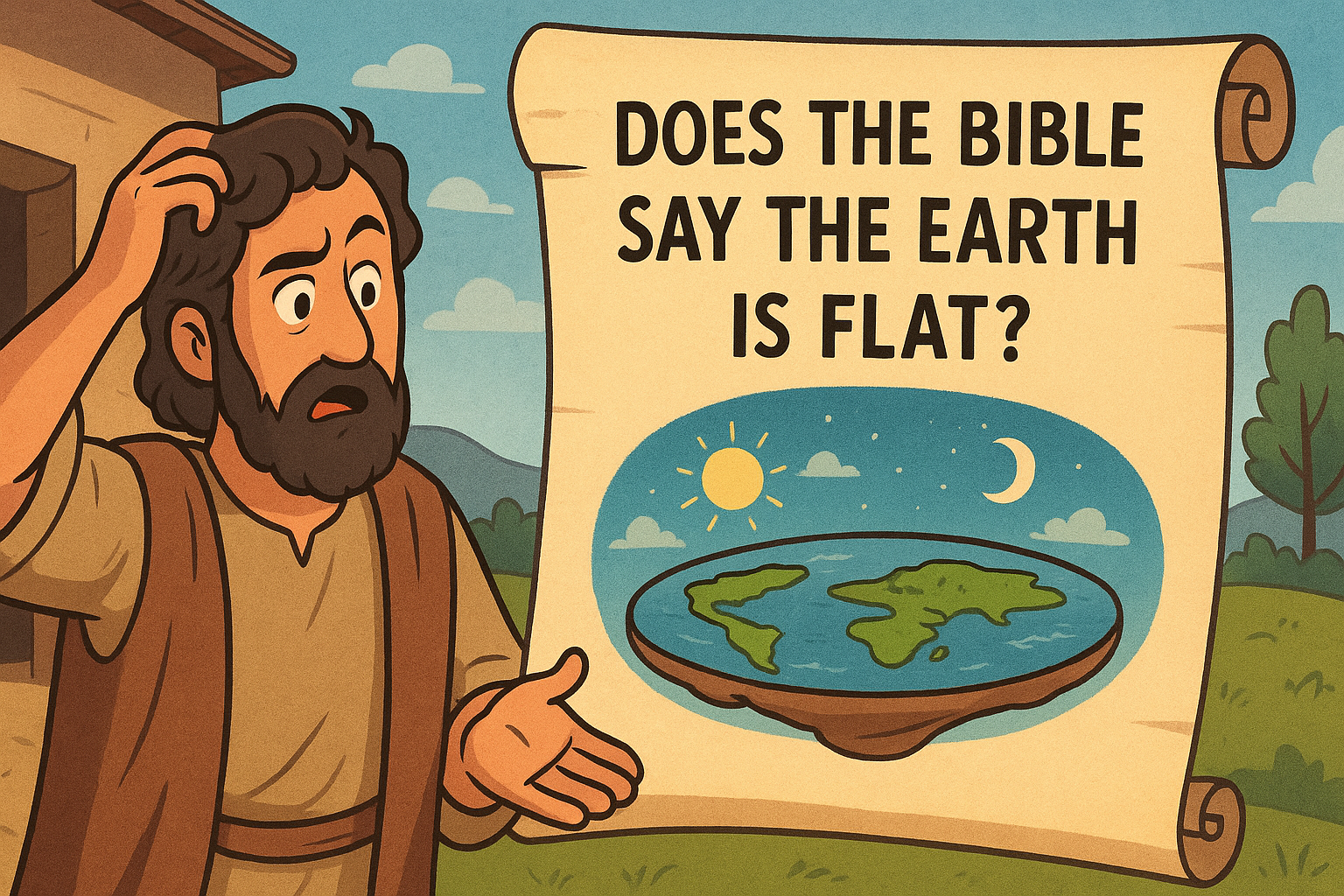
The question of whether the Bible indicates that the Earth is flat has garnered interest and debate among scholars, theologians, and laypeople alike. While some argue that certain biblical passages suggest a flat Earth, others contend that these interpretations may be based on misunderstanding or misreading the texts. This article will explore relevant scripture and context to clarify what the Bible says about the shape of the Earth.
Directly answering the question, the Bible does not explicitly state that the Earth is flat. Various passages can be interpreted in different ways, but many scholars argue that the scriptures reflect an understanding of the Earth that is more complex than a simple flat model. Let’s examine some of the key verses and their contexts.
Key Biblical Passages and Interpretations
Isaiah 40:22
One of the most frequently cited verses in this discussion is Isaiah 40:22, which states, “He sits enthroned above the circle of the earth, and its people are like grasshoppers.” This verse describes God’s sovereignty over the Earth and uses the term “circle” to depict the Earth. Some proponents of the flat Earth theory argue that “circle” implies a flat, disc-like shape. However, many scholars interpret this as a reference to the Earth’s roundness, as the Hebrew word used here can denote a spherical shape as well.
Job 26:7
Another passage often referenced is Job 26:7, which says, “He spreads out the northern skies over empty space; he suspends the earth over nothing.” This verse emphasizes God’s power in creation. The imagery of the Earth being suspended indicates a more three-dimensional understanding rather than a flat surface. The context of this passage highlights the majesty of God’s creation, which many see as compatible with a spherical Earth.
Matthew 4:8
In the New Testament, Matthew 4:8 describes the devil taking Jesus to a high mountain and showing him “all the kingdoms of the world and their glory.” Some flat Earth proponents argue that this implies a limitation of vision that would only be possible on a flat surface. However, this passage is more about the temptation of Jesus rather than a scientific statement about geography. It serves to illustrate the scope of worldly power rather than provide a literal depiction of the Earth’s shape.
Understanding the Context and Language
Hebrew Cosmology
To fully grasp the biblical perspective, it is essential to understand the cosmology of ancient Hebrew thought. The ancient Hebrews viewed the world in a way that reflected their cultural and historical context. They described the Earth as a flat surface with a dome-like sky above, a common belief in many ancient cultures. These descriptions were not meant to be scientific but served to convey theological truths about God’s creation.
Metaphorical Language
Many passages in the Bible use metaphorical language to convey spiritual truths. For instance, descriptions of the Earth “spreading out” or being “established” often reflect God’s authority and creativity rather than literal geographical descriptions. When interpreting these poetic and metaphorical texts, it is crucial to distinguish between the intended meaning and a modern scientific understanding of the Earth’s shape.
Scientific Understanding and Historical Context
Ancient Beliefs vs. Modern Science
Throughout history, various cultures have held different beliefs about the shape of the Earth. By the time of the early Christian church, the prevailing scientific understanding among educated people was that the Earth was round. Figures like Aristotle and later Ptolemy provided arguments for a spherical Earth based on observation and reasoning. Early Christians, influenced by these ideas, generally accepted the round Earth model.
Church Fathers and the Shape of the Earth
Many early church fathers, such as Augustine and Aquinas, also acknowledged the Earth’s roundness. They interpreted scripture within the context of prevailing scientific thought, suggesting that the Bible and science could coexist without contradiction. This historical context shows that the flat Earth interpretation is not a mainstream view among biblical scholars or church leaders throughout history.
Conclusion of the First Half
As we examine the evidence and interpretations surrounding the question of whether the Bible states that the Earth is flat, we see a complex interplay of scripture, language, and historical context. The verses cited often reflect the cosmological understanding of the time rather than definitive statements about the Earth’s shape. In the next section, we will delve deeper into additional passages and contemporary interpretations to provide a more comprehensive view of this topic.
Additional Biblical Passages Relevant to Earth’s Shape
Psalms 104:5
Psalms 104:5 states, “The earth is established; it shall never be moved.” This verse can be interpreted as affirming the stability of the Earth, which some may misconstrue as a flat perspective. However, it is more often understood as a declaration of God’s sovereignty and the order He has established in creation. The focus here is less about the physical shape of the Earth and more about its unshakeable nature in God’s plan.
Revelation 7:1
In Revelation 7:1, the apostle John describes seeing four angels standing at the four corners of the earth, holding back the winds. Some proponents of a flat Earth interpretation might see this as literal evidence of a flat Earth. However, many theologians argue that “four corners” is figurative language representing the entirety of the Earth. This reflects a common literary device used in Scripture to signify completeness rather than a description of physical geography.
Interpreting Scripture in Light of Modern Science
The Role of Cultural Context
Understanding the cultural context in which the Bible was written is crucial for interpreting its texts correctly. The ancient world had different cosmological views that shaped their language and descriptions. Just as modern readers use language that reflects contemporary understanding, biblical authors used their cultural frameworks to convey truths about God and creation. Recognizing this can help clarify many of the metaphorical expressions found in Scripture.
Dialogue Between Faith and Science
The relationship between faith and science is often viewed as contentious, but many theologians advocate for a dialogue that respects both realms. The Bible is not a scientific textbook; it communicates theological truths and moral teachings. As science has developed, particularly in understanding the universe’s structure, many Christians have found ways to reconcile their faith with scientific discoveries. This perspective encourages believers to view the Bible as a source of spiritual wisdom rather than a literal scientific account.
Contemporary Views on Biblical Interpretation
Flat Earth Theories in Modern Context
In contemporary discussions, flat Earth theories have gained attention, particularly among certain groups that prioritize literal interpretations of Scripture. However, many scholars and theologians argue that these interpretations often overlook the broader context of biblical texts and the historical understanding of the authors. Engaging with a variety of interpretations can enrich one’s faith and understanding of Scripture.
Importance of Theological Interpretation
When examining the shape of the Earth in the context of the Bible, it is vital to consider theological interpretation over scientific assertion. The Bible aims to guide believers in their relationship with God, illustrating His majesty and sovereignty rather than providing a scientific framework for understanding the natural world. Thus, interpretations that emphasize spiritual truths can often be more fruitful than those that seek to assert a specific scientific claim.
Questions for Further Reflection
What is the Purpose of the Biblical Text?
When reading Scripture, it is helpful to ask what the primary purpose of the text is. Are the authors attempting to convey scientific knowledge, or are they sharing theological truths? Reflecting on this can help readers understand the intent behind the language and imagery used in the Bible.
How Does Understanding Cosmology Affect Faith?
Consider how understanding ancient cosmology can affect one’s faith. Does knowing the historical context of biblical texts enhance your appreciation for their spiritual messages? Engaging with the cultural background of Scripture can lead to a deeper connection with the text and a more robust faith journey.
Can Science and Faith Coexist Harmoniously?
Another important question is whether science and faith can coexist harmoniously. How do modern scientific discoveries inform your understanding of the Bible? Many find that science enriches their faith, allowing them to appreciate God’s creation in new ways while maintaining a strong spiritual foundation.
Final Thoughts on the Shape of the Earth in the Bible
In conclusion, the Bible does not explicitly assert that the Earth is flat, nor does it provide a definitive statement regarding its shape. Instead, it presents a range of poetic and metaphorical language that reflects the cultural and historical context of its authors. As modern readers, it is crucial to approach Scripture with an understanding of its intent, recognizing that its primary focus is on God’s relationship with humanity rather than scientific accuracy. Engaging with both the biblical text and contemporary scientific understanding can lead to a more profound appreciation for the mysteries of creation and the divine nature of God. Ultimately, the shape of the Earth is less significant than the message of hope, love, and redemption that the Bible conveys to its readers.